$Ledger & Co. Lessons
Lessons › Saving & emergency fund
Free lesson outline · Grades 9-12

Saving lesson: emergency fund and savings goals

A savings habit is built on two ideas: a specific goal with a date, and a cushion for the things nobody plans for. This lesson covers both with simple weekly math.

45-minute lesson plan

ObjectiveStudents write a SMART savings goal, compute the weekly amount needed to reach it, estimate a 3-6 month emergency fund for a sample budget and compare interest at a low and a high APY.
  1. 5 minstep 1
    Warm-up: "Name one thing you'd like to buy in the next year. How much is it, and when do you want it?"
  2. 10 minstep 2
    SMART goals (specific, measurable, achievable, relevant, time-bound) and the emergency fund idea: about 3-6 months of essential expenses, starting with a small first target.
  3. 15 minstep 3
    Goal math: students divide their goal by the weeks available, then test two saving rates.
  4. 10 minstep 4
    APY compare: the same balance in an account paying 0.01% vs. one paying an example 4% for a year; where high-yield savings accounts are found and how they are insured.
  5. 5 minstep 5
    Exit ticket: their goal written as a SMART goal with a weekly amount.

Discussion questions

  • Why keep an emergency fund in savings instead of investing it?
  • What counts as an emergency, and what does not?
  • How can automatic transfers make saving easier?
  • What should you do after you use your emergency fund?

Ready-to-print resources: Saving & emergency fund

Printable resources from our store on Teachers Pay Teachers. What's included is taken from each listing.

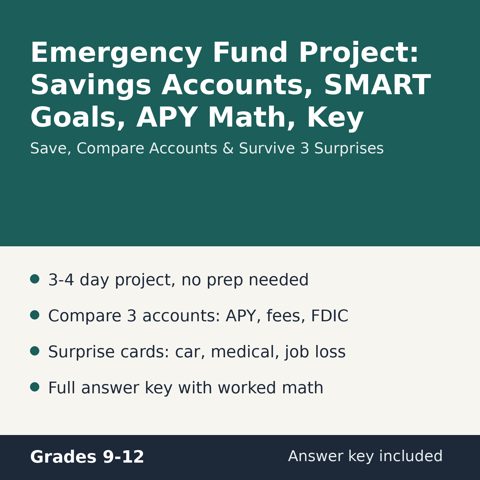
Cover: Emergency Fund Project: Savings Accounts, SMART Goals, APY Math, Key
$8

Emergency Fund Project: Savings Accounts, SMART Goals, APY Math, Key

Teach saving with a project students actually finish: build an emergency fund for a young adult, then see if it survives three real-life surprises.

  • Teacher overview with day-by-day plan
  • Start Here reading: emergency funds, pay yourself first, automatic transfers, liquidity vs....
  • Part 1: Jordan's budget, needs vs. wants
  • Part 2: 3- and 6-month targets
Answer key included
View on TPT →
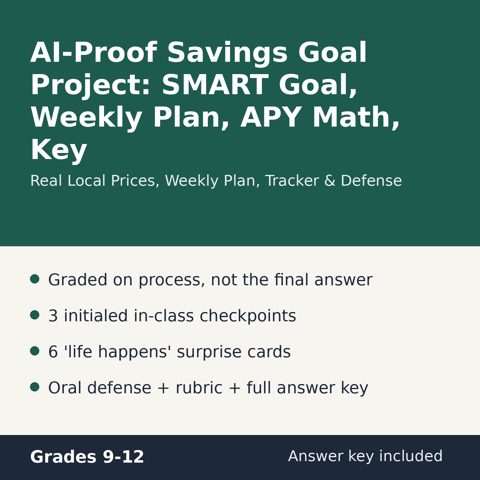
Cover: AI-Proof Savings Goal Project: SMART Goal, Weekly Plan, APY Math, Key
$7

AI-Proof Savings Goal Project: SMART Goal, Weekly Plan, APY Math, Key

Students can't copy a savings plan built on their own town's prices.

  • Teacher overview and run guide (timing, standards, no-device option)
  • 6 'Life Happens' surprise cards with exact dollar amounts
  • Student overview and timeline with 3 initialed checkpoints
  • Goal and price page: source + date for every number, draft SMART goal
14 pages · Answer key included
View on TPT →
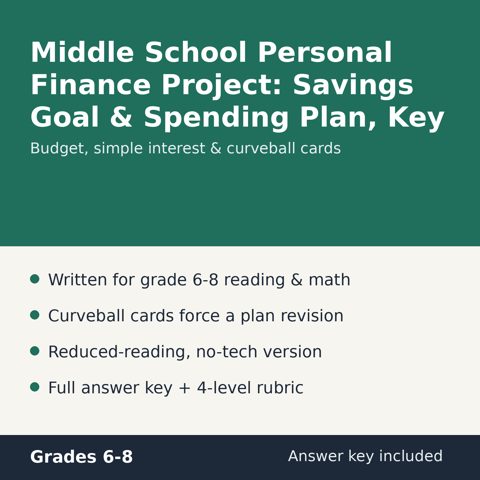
Cover: Middle School Personal Finance Project: Savings Goal & Spending Plan, Key
$6.5

Middle School Personal Finance Project: Savings Goal & Spending Plan, Key

Plan one month of money for a 13-year-old, pick a savings goal, and then survive a curveball.

  • Teacher overview, timing, standards, and how to run it
  • Differentiation notes and a 4-criteria rubric (16 points)
  • Money situation reading + goal menu (4 goals)
  • Income card deck and expense card deck with needs vs wants sort
14 pages · Answer key included
View on TPT →
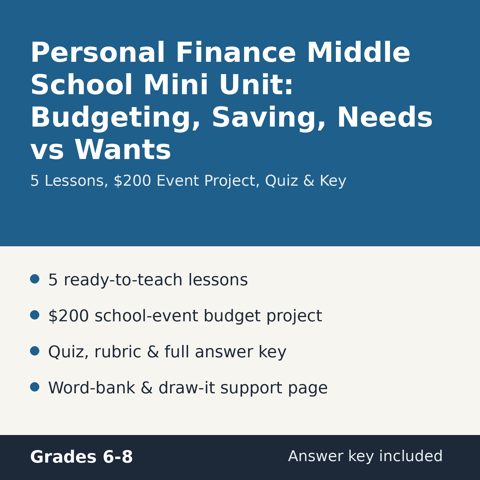
Cover: Personal Finance Middle School Mini Unit: Budgeting, Saving, Needs vs Wants
$8

Personal Finance Middle School Mini Unit: Budgeting, Saving, Needs vs Wants

Teaching personal finance in middle school? This no-prep mini-unit takes grades 6-8 from needs vs wants to a real budget plan in 5 short lessons. Print and teach.

  • Page 1: Teacher overview (objectives, timing, how to run it, standards)
  • Page 2: Lesson 1, Needs vs Wants and opportunity cost
  • Page 3: Lesson 2, Your First Paycheck (gross vs net, payroll tax math)
  • Page 4: Lesson 3, Build a simple monthly budget
14 pages · Answer key included
View on TPT →

4 resources on this topic in total. Browse the whole store on TPT →

Questions teachers ask

How big should an emergency fund be?

A common guideline is 3-6 months of essential expenses. For a student or first-year worker, a starter goal like $500-$1,000 is a useful first step.

What does APY mean?

Annual percentage yield: the yearly interest an account earns including compounding.

More lesson topics