$Ledger & Co. Lessons
Lessons › Accounting 1
Free lesson outline · Grades 9-12

Accounting 1: journal entries lesson plan

Debits and credits click when students record a small business's real-looking month. This outline follows one shop from journal entries to a trial balance that has to balance.

45-minute lesson plan

ObjectiveStudents apply the accounting equation, record transactions as journal entries with equal debits and credits, post them to T-accounts and prepare a trial balance.
  1. 5 minstep 1
    Warm-up: "The owner puts $5,000 into the business. What two things change?" Introduce Assets = Liabilities + Owner's Equity.
  2. 10 minstep 2
    Debit and credit rules by account type, with one worked example: buying supplies on account.
  3. 20 minstep 3
    Students journalize a short list of a small shop's transactions (owner investment, supplies, revenue, rent, a payment on account) and post them to T-accounts.
  4. 5 minstep 4
    Trial balance: total debit and credit balances; if they don't match, trace the error.
  5. 5 minstep 5
    Exit ticket: journalize one new transaction correctly.

Discussion questions

  • Why must every transaction affect at least two accounts?
  • Is a trial balance that balances always correct? What errors can it miss?
  • How is owner's withdrawal different from an expense?
  • Why would a business owner care about an income statement each month?

Ready-to-print resources: Accounting 1

Printable resources from our store on Teachers Pay Teachers. What's included is taken from each listing.

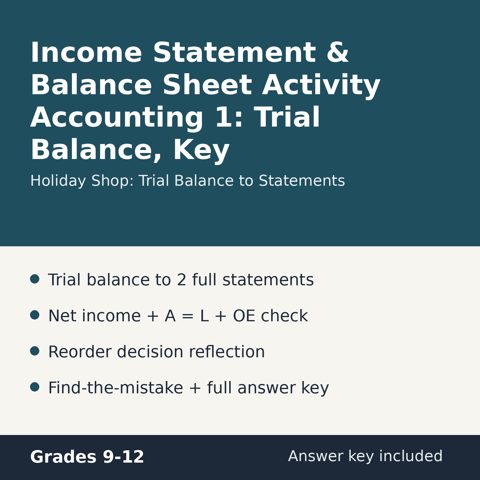
Cover: Income Statement & Balance Sheet Activity Accounting 1: Trial Balance, Key
$6

Income Statement & Balance Sheet Activity Accounting 1: Trial Balance, Key

Students take a finished trial balance for a small seasonal shop and turn it into the two statements every owner and lender reads: the income statement and the balance sheet.

  • Teacher overview: objectives, pacing, simplifications, quick-answer facts
  • Reading: the shop, the two statements, key formulas
  • Trial balance to check and analyze
  • Sort the accounts by type and statement
14 pages · Answer key included
View on TPT →
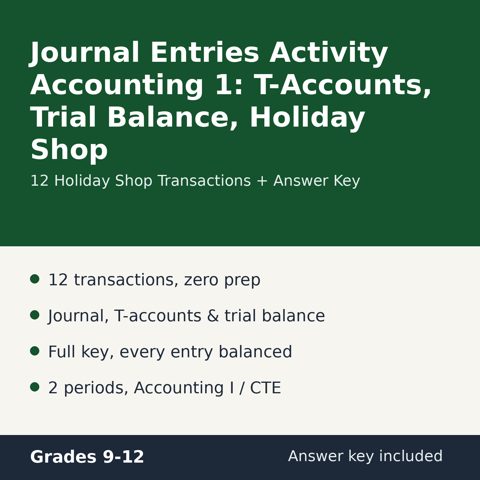
Cover: Journal Entries Activity Accounting 1: T-Accounts, Trial Balance, Holiday Shop
$6.5

Journal Entries Activity Accounting 1: T-Accounts, Trial Balance, Holiday Shop

Your Accounting I students keep the books for a holiday pop-up shop and finish with a trial balance that actually balances.

  • Teacher overview, timing, and how to run it
  • Common mistakes and a find-the-error checklist
  • Shop story and 12 transactions
  • Chart of accounts (11 accounts) with debit/credit rules and warm-up
14 pages · Answer key included
View on TPT →
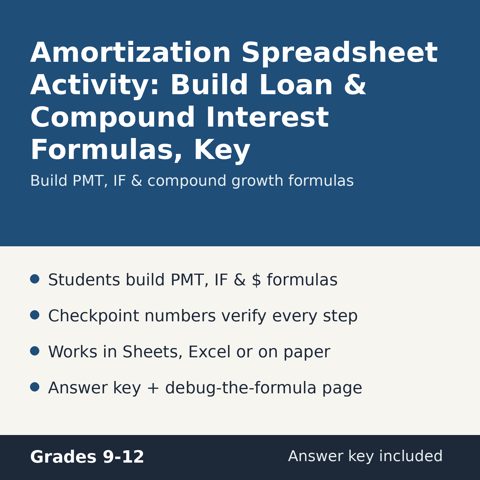
Cover: Amortization Spreadsheet Activity: Build Loan & Compound Interest Formulas, Key
$7

Amortization Spreadsheet Activity: Build Loan & Compound Interest Formulas, Key

Students don't fill in a worksheet. They build the formulas.

  • Teacher overview: objectives, standards, pacing, tips
  • Spreadsheet toolkit reading + quick check
  • Day 1 Parts A-C: inputs, the amortization table, loan-term what-if, extra-payment challenge
  • Debug Desk: find and fix 5 broken formulas
Answer key included
View on TPT →

3 resources on this topic in total. Browse the whole store on TPT →

Questions teachers ask

What is the accounting equation?

Assets = Liabilities + Owner's Equity. Every journal entry keeps it in balance.

Does a debit always mean an increase?

No. Debits increase assets, expenses and owner's withdrawals, and decrease liabilities, equity and revenue.

More lesson topics