$Ledger & Co. Lessons
Lessons › Life after graduation
Free lesson outline · Grades 9-12

Life after high school: real-world money lesson

Seniors want to know what it actually costs to live on their own. This plan turns that curiosity into math: an entry-level job, a first apartment, a first car and the budget that has to hold it all together.

45-minute lesson plan

ObjectiveStudents choose an entry-level job, estimate take-home pay, pick housing and transportation they can afford (rent at or below about 30% of gross income) and present a balanced first-month budget.
  1. 5 minstep 1
    Warm-up: "What do you think it costs per month to live on your own in our town?" Write guesses down to revisit.
  2. 10 minstep 2
    From salary to take-home: estimate net pay from an entry-level wage; introduce the 30%-of-gross rent guideline and move-in costs (deposit, first month, utilities setup).
  3. 20 minstep 3
    Choose and total: students pick an apartment and a car option (used car loan, lease, transit) from listings or cards, including insurance and gas, then build the first-month budget.
  4. 5 minstep 4
    Reality check: compare totals with the warm-up guesses.
  5. 5 minstep 5
    Exit ticket: the one choice that made their budget work.

Discussion questions

  • Is it better to have a roommate or a longer commute? Why?
  • What upfront costs come with a first apartment besides rent?
  • Why can a cheaper car cost more over five years?
  • What would you cut first if your hours at work were reduced?

Ready-to-print resources: Life after graduation

Printable resources from our store on Teachers Pay Teachers. What's included is taken from each listing.

Cover: AI-Proof Life After Graduation Project: Real Local Costs, Budget & Defense
$7

AI-Proof Life After Graduation Project: Real Local Costs, Budget & Defense

Looking for a Life After Graduation project students can't just hand to a chatbot? This one is graded on PROCESS, not a final answer, and every number comes from the student's own local research.

  • Teacher overview + how to run checkpoints, surprise cards, oral defense
  • Student overview, timeline, 3 in-class checkpoints with teacher initials boxes
  • 2 Personal Data pages: every number has a source + date seen column
  • Year-1 budget work page and 5-year comparison page
14 pages · Answer key included
View on TPT →
Cover: Renting an Apartment Project: Lease, Deposit & Budget, A/B, Updated for 2026
$8

Renting an Apartment Project: Lease, Deposit & Budget, A/B, Updated for 2026

Ready for your housing unit? This no-prep, 3-day project has students shop for a first apartment the way renters really do.

  • Teacher overview, 3-day plan, differentiation notes, common-mistakes checklist
  • Student reading: Renting 101 with 5 questions
  • 4 fictional apartment listings (one with roommates)
  • 1-page sample lease with 6 clauses
14 pages · Answer key included
View on TPT →
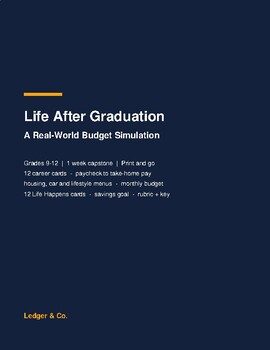
Cover: Life After Graduation Project | Paycheck, Budget & Events | Personal Finance
$7

Life After Graduation Project | Paycheck, Budget & Events | Personal Finance

  • Paycheck, Budget & Events
View on TPT →
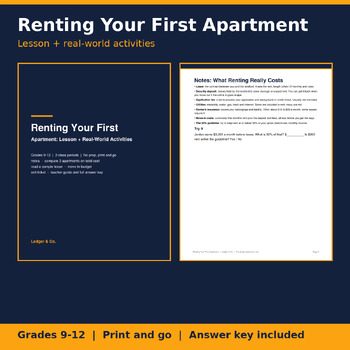
Cover: Renting Your First Apartment | Lease, Budget & Move-In Costs | Personal Finance
$5

Renting Your First Apartment | Lease, Budget & Move-In Costs | Personal Finance

  • Lease, Budget & Move-In Costs
View on TPT →
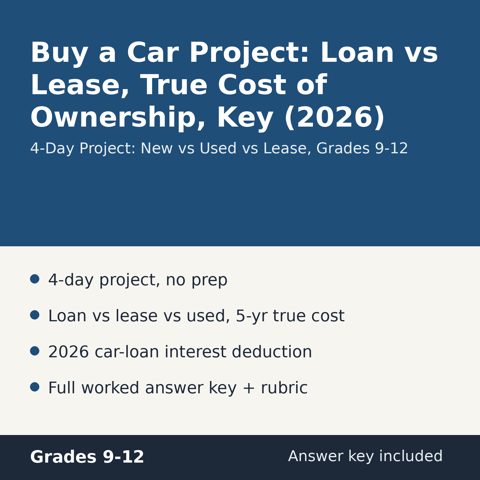
Cover: Buy a Car Project: Loan vs Lease, True Cost of Ownership, Key (2026)
$8

Buy a Car Project: Loan vs Lease, True Cost of Ownership, Key (2026)

Students act as Jordan's financial advisor and decide how to get a car: buy new with a loan, buy used with a loan, or lease.

  • Teacher overview: objectives, pacing, standards, support and stretch tips
  • Day 1: reading on total cost of ownership + Jordan's three options
  • Day 2: loan payment and interest math (payment-per-$1,000 table), rate and term what-ifs,...
  • Day 3: 5-year cost of ownership table + car-loan interest deduction reading, with income...
14 pages · Answer key included
View on TPT →
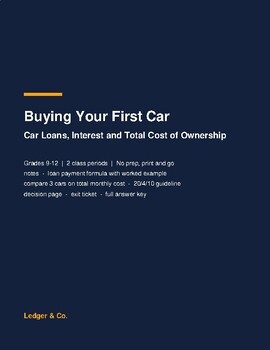
Cover: Buying Your First Car | Car Loans, Interest & Total Cost | Personal Finance
$5

Buying Your First Car | Car Loans, Interest & Total Cost | Personal Finance

  • Car Loans, Interest & Total Cost
View on TPT →
Cover: Life After High School Bundle: College Costs, Car, Apartment, Insurance, Taxes
Bundle · $54.99

Life After High School Bundle: College Costs, Car, Apartment, Insurance, Taxes

Ten ready-to-teach personal finance resources for juniors and seniors about the first year after high school: the first paycheck and tax forms, renting, buying a car, insurance, paying for college and student loans, side jobs and an...

  • Life After Graduation Project: A first paycheck, a first budget and the surprises of the...
  • Pay Stub & Form 1040 Mini Unit: Read a pay stub, fill in a W-4 and follow a W-2 to a first...
  • Renting an Apartment Project: What a lease, a deposit and move-in really cost
  • Buy a Car Project: Loan or lease, and the true cost of owning a car
View on TPT →
Cover: Personal Finance Projects Bundle: Paycheck, Budget, Apartment, Car, Graduation
Bundle · $24.99

Personal Finance Projects Bundle: Paycheck, Budget, Apartment, Car, Graduation

Five print-and-go personal finance projects for high school in one bundle, plus a bundle guide with a suggested order and a capstone reflection with a rubric.

  • Paycheck to Budget Project: turn a paycheck into a monthly budget
  • Renting Your First Apartment: lease terms, move-in costs, rent in a budget
  • Buy a Car Project: Loan vs Lease, True Cost of Ownership, Key (2026): loan vs lease and the...
  • Life After Graduation Project: paycheck, budget and life events after high school
Answer key included
View on TPT →

8 resources on this topic in total. Browse the whole store on TPT →

Questions teachers ask

How much rent can a first-year worker afford?

A common guideline is no more than about 30% of gross monthly income for rent. Many landlords also ask that income be about three times the rent.

How many class periods does a life-after-graduation project take?

Most versions take 3-5 class periods: one for income, one or two for housing and transportation, and one for the final budget and presentation.

More lesson topics