$Ledger & Co. Lessons
Lessons › Elementary & middle school money
Free lesson outline · Grades 1-8

Money lessons for elementary and middle school

Younger students learn money by handling it: counting coins, making change, choosing between two wants and watching a savings jar grow. This outline scales from first grade to middle school.

45-minute lesson plan

ObjectiveStudents count money and make change at their grade level, sort needs and wants, and set a simple savings goal; older students build a basic spending plan.
  1. 5 minstep 1
    Warm-up: a coin or bill riddle ("I'm worth 25 cents...") or a quick change-making problem.
  2. 10 minstep 2
    Model the day's skill with real or printed money: counting on to make change, or needs vs. wants with picture cards.
  3. 20 minstep 3
    Classroom store: students buy items with a set budget, make change for a partner and record what they spent.
  4. 5 minstep 4
    Save, spend, share: each student chooses how to split a small allowance and explains why.
  5. 5 minstep 5
    Exit ticket: one money problem at their level.

Discussion questions

  • What is something you need every day? Something you want?
  • If you save $2 a week, how long until you have $20?
  • Why do people put money in a bank instead of a jar?
  • How would you spend $10 at the class store?

Ready-to-print resources: Elementary & middle school money

Printable resources from our store on Teachers Pay Teachers. What's included is taken from each listing.
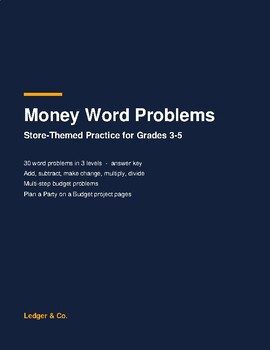
Cover: Money Word Problems | Making Change, Multi-Step & Party on a Budget | Grades 3-5
$4

Money Word Problems | Making Change, Multi-Step & Party on a Budget | Grades 3-5

  • Making Change, Multi-Step & Party on a Budget
  • Grades 3-5
View on TPT →
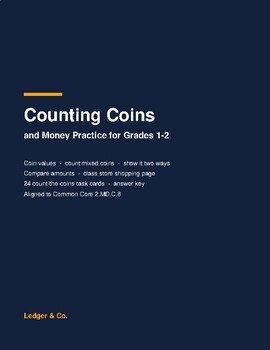
Cover: Counting Coins and Money Practice | Coin Values, Task Cards & Store | Grades 1-2
$4

Counting Coins and Money Practice | Coin Values, Task Cards & Store | Grades 1-2

  • Coin Values, Task Cards & Store
  • Grades 1-2
View on TPT →
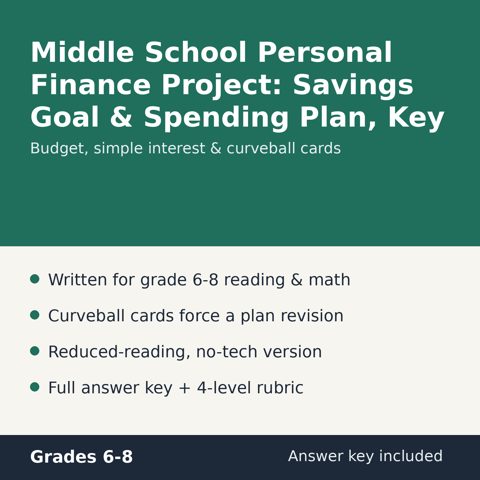
Cover: Middle School Personal Finance Project: Savings Goal & Spending Plan, Key
$6.5

Middle School Personal Finance Project: Savings Goal & Spending Plan, Key

Plan one month of money for a 13-year-old, pick a savings goal, and then survive a curveball.
  • Teacher overview, timing, standards, and how to run it
  • Differentiation notes and a 4-criteria rubric (16 points)
  • Money situation reading + goal menu (4 goals)
  • Income card deck and expense card deck with needs vs wants sort
14 pages · Answer key included
View on TPT →
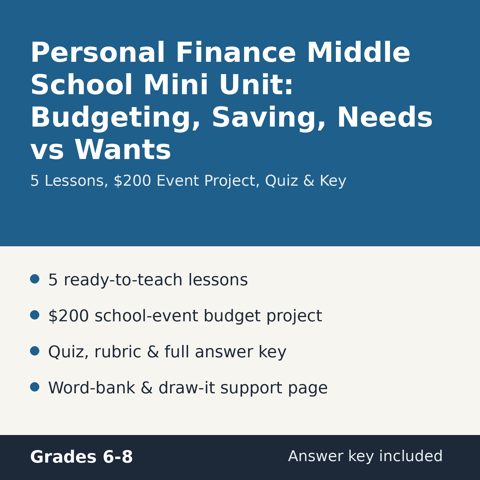
Cover: Personal Finance Middle School Mini Unit: Budgeting, Saving, Needs vs Wants
$8

Personal Finance Middle School Mini Unit: Budgeting, Saving, Needs vs Wants

Teaching personal finance in middle school? This no-prep mini-unit takes grades 6-8 from needs vs wants to a real budget plan in 5 short lessons. Print and teach.
  • Page 1: Teacher overview (objectives, timing, how to run it, standards)
  • Page 2: Lesson 1, Needs vs Wants and opportunity cost
  • Page 3: Lesson 2, Your First Paycheck (gross vs net, payroll tax math)
  • Page 4: Lesson 3, Build a simple monthly budget
14 pages · Answer key included
View on TPT →
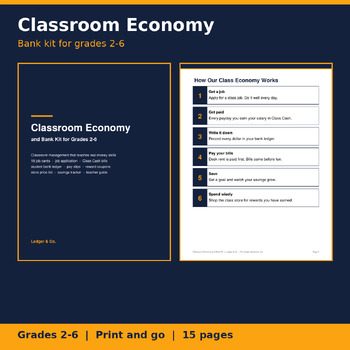
Cover: Classroom Economy System | Class Money, Jobs, Bank Ledger | Classroom Management
$8

Classroom Economy System | Class Money, Jobs, Bank Ledger | Classroom Management

  • Class Money, Jobs, Bank Ledger
  • Classroom Management
View on TPT →
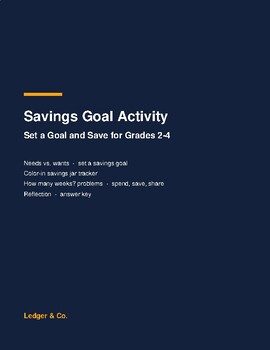
Cover: Savings Goal Activity | Needs vs Wants, Spend Save Share & Tracker | Grades 2-4
$3

Savings Goal Activity | Needs vs Wants, Spend Save Share & Tracker | Grades 2-4

  • Needs vs Wants, Spend Save Share & Tracker
  • Grades 2-4
View on TPT →

6 resources on this topic in total. Browse the whole store on TPT →

Questions teachers ask

At what age should kids learn about money?

Basic ideas like counting coins, needs vs. wants and saving fit early elementary grades; budgeting and interest fit upper elementary and middle school.

What is a classroom economy?

A system where students earn class money for jobs, pay for privileges or rent, and keep records, practicing money skills every day.

More lesson topics