$Ledger & Co. Lessons
Lessons › Economics in personal finance
Free lesson outline · Grades 9-12

Economics in personal finance

Economic ideas show up in every money decision: what you give up, why prices rise and who really pays a tax on imports. This lesson ties each one to a student-sized decision.

45-minute lesson plan

ObjectiveStudents identify the opportunity cost of a choice, compute the effect of inflation on purchasing power (real vs. nominal), and explain how a tariff can pass through to consumer prices.
  1. 5 minstep 1
    Warm-up: "You have Saturday free: work a 6-hour shift for $90 or go to a concert that costs $40. What does the concert really cost?"
  2. 10 minstep 2
    Opportunity cost and trade-offs, then inflation: a raise smaller than inflation is a pay cut in real terms.
  3. 15 minstep 3
    Real vs. nominal: students adjust a wage or benefit increase for an example inflation rate.
  4. 10 minstep 4
    Supply, demand and tariffs: follow an example imported item's cost from port to shelf and discuss who pays.
  5. 5 minstep 5
    Exit ticket: one personal decision this week and its opportunity cost.

Discussion questions

  • If your pay rises 3% and prices rise 4%, are you better or worse off?
  • What is the opportunity cost of going to college? Of not going?
  • Why do prices sometimes rise even when a store's own costs don't?
  • How does inflation affect someone who keeps all their savings in cash?

Ready-to-print resources: Economics in personal finance

Printable resources from our store on Teachers Pay Teachers. What's included is taken from each listing.

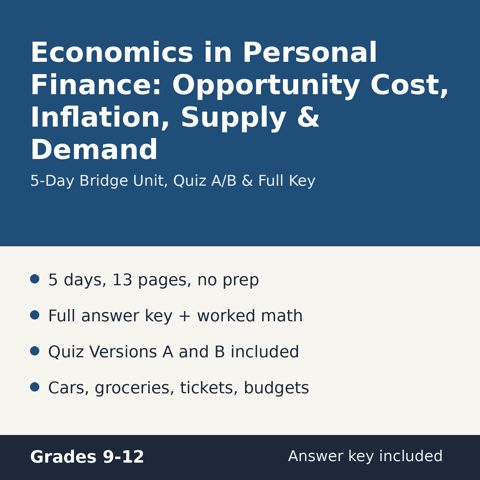
Cover: Economics in Personal Finance: Opportunity Cost, Inflation, Supply & Demand
$7.5

Economics in Personal Finance: Opportunity Cost, Inflation, Supply & Demand

Your course became personal finance, but your standards still expect economics.

  • Teacher overview: objectives, pacing table, standards, data notes
  • Day 1: Opportunity cost. Buy a car outright, or buy a cheaper one and invest the difference
  • Day 2 (2 pages): Inflation with a 6-item grocery basket, percent change, buying power,...
  • Day 3: Supply and demand schedule, shortage and surplus, event shifts, resale profit math
13 pages · Answer key included
View on TPT →
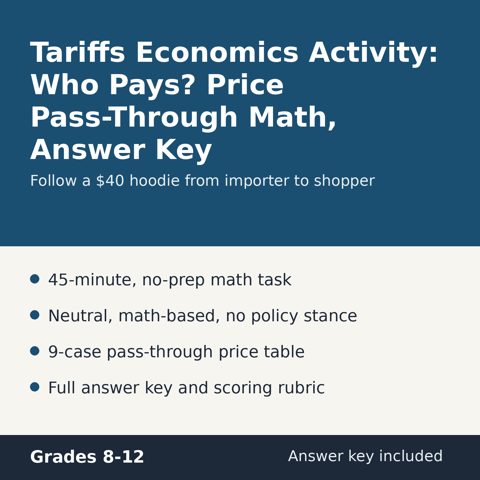
Cover: Tariffs Economics Activity: Who Pays? Price Pass-Through Math, Answer Key
$4.5

Tariffs Economics Activity: Who Pays? Price Pass-Through Math, Answer Key

Who really pays when a tariff is added to a price? Students find out with numbers, not opinions.

  • Teacher overview, pacing, standards, background and neutral-framing tips (2 pages)
  • Student reading: Follow the Hoodie, with vocabulary and check questions
  • Part 1: tariff calculations at 10%, 25% and 50%
  • Part 2: 9-case price tracing table (3 scenarios x 3 rates)
14 pages · Answer key included
View on TPT →
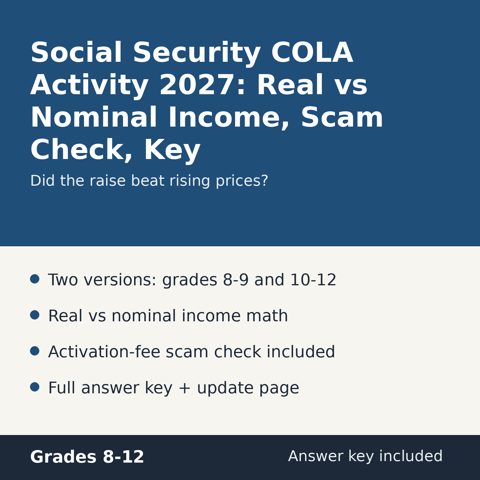
Cover: Social Security COLA Activity 2027: Real vs Nominal Income, Scam Check, Key
$5

Social Security COLA Activity 2027: Real vs Nominal Income, Scam Check, Key

Every winter, retirees get a Social Security raise called a COLA. Scammers know it, and they text and call to charge an "activation fee" for a raise that is automatic and free.

13 pages · Answer key included
View on TPT →

3 resources on this topic in total. Browse the whole store on TPT →

Questions teachers ask

What is the difference between real and nominal income?

Nominal income is the dollar amount; real income adjusts it for inflation to show what it can actually buy.

What is opportunity cost?

The value of the next-best option you give up when you make a choice.

More lesson topics