$Ledger & Co. Lessons
Lessons › Paying for college
Free lesson outline · Grades 9-12

Paying for college: award letter lesson plan

An award letter can make an expensive school look cheap by mixing loans in with grants. This lesson teaches seniors to find the one number that matters: what they will actually pay.

45-minute lesson plan

ObjectiveStudents separate free money (grants, scholarships) from earned and borrowed money (work-study, loans), compute net price for two award letters and estimate a monthly loan payment.
  1. 5 minstep 1
    Warm-up: "School A costs $30,000 and gives you $20,000 in aid. School B costs $22,000 and gives $8,000. Which is cheaper?"
  2. 10 minstep 2
    FAFSA basics and aid types: grants and scholarships (keep), work-study (earn), federal and private loans (repay with interest).
  3. 20 minstep 3
    Award letter compare: students subtract only grants and scholarships from the cost of attendance to find net price, then list the loans each school includes.
  4. 5 minstep 4
    Repayment preview: estimate a monthly payment for a sample loan balance with an example rate.
  5. 5 minstep 5
    Exit ticket: the school they'd pick and the number that decided it.

Discussion questions

  • Why should loans not count as aid when comparing schools?
  • What questions could you ask a financial aid office?
  • What happens if a student loan goes into default?
  • How do community college, trade school or working first change the math?

Ready-to-print resources: Paying for college

Printable resources from our store on Teachers Pay Teachers. What's included is taken from each listing.
Cover: Paying for College | FAFSA, Financial Aid & Student Loans | Personal Finance
$5

Paying for College | FAFSA, Financial Aid & Student Loans | Personal Finance

  • FAFSA, Financial Aid & Student Loans
View on TPT →
Cover: College Award Letter Activity: Compare Net Price, Loans & Work-Study, Key
$8

College Award Letter Activity: Compare Net Price, Loans & Work-Study, Key

Seniors are getting college offers, and most have never read an award letter closely. This project gives them three fictional letters and one question: which college really costs the least?
  • Teacher overview, assumptions, and how to run it
  • Key terms reading with quick check
  • 3 award letters (public, private, private)
  • Step 1: Sort aid and find net price
13 pages · Answer key included
View on TPT →
Cover: Student Loan Repayment Plan Activity: RAP vs Tiered Standard Math, Key
$6

Student Loan Repayment Plan Activity: RAP vs Tiered Standard Math, Key

Loan repayment changed on July 1, 2026. New federal borrowers now choose between just two plans: the Tiered Standard Plan and the Repayment Assistance Plan (RAP).
  • Teacher overview, pacing, and assumptions page
  • Student Page 1: Two plans reading + check questions
  • Student Page 2: RAP bracket table + 6 practice problems
  • Student Page 3: Tiered Standard terms, payment table + practice
14 pages · Answer key included
View on TPT →
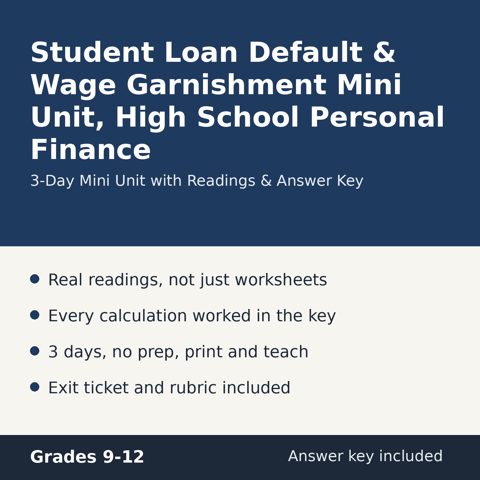
Cover: Student Loan Default & Wage Garnishment Mini Unit, High School Personal Finance
$7.5

Student Loan Default & Wage Garnishment Mini Unit, High School Personal Finance

Default and wage garnishment are the part of student loans nobody explains until it is too late. This 3-day mini unit makes it concrete with real readings, real math and a role-play. No prep needed.

Answer key included
View on TPT →
Cover: Fix the AI Activity: Student Loans & RAP Repayment Plans, 8 Errors, Key
$5

Fix the AI Activity: Student Loans & RAP Repayment Plans, 8 Errors, Key

Chatbots still describe student loan rules that changed on July 1, 2026. In this activity, students act as fact-checkers.
  • Teacher overview: objectives, timing, standards, how to run it
  • Reference sheet: Tiered Standard terms, RAP rules, loan basics
  • The chatbot's answer, with numbered sentences to mark up
  • Error log: wrong claim, correct fact, proof
12 pages · Answer key included
View on TPT →
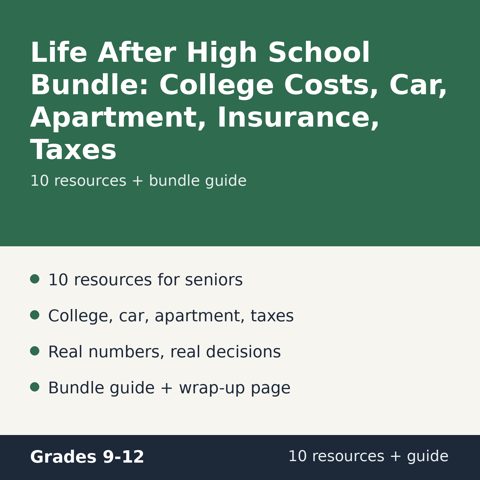
Cover: Life After High School Bundle: College Costs, Car, Apartment, Insurance, Taxes
Bundle · $54.99

Life After High School Bundle: College Costs, Car, Apartment, Insurance, Taxes

Ten ready-to-teach personal finance resources for juniors and seniors about the first year after high school: the first paycheck and tax forms, renting, buying a car, insurance, paying for college and student loans, side jobs and an...

  • Life After Graduation Project: A first paycheck, a first budget and the surprises of the...
  • Pay Stub & Form 1040 Mini Unit: Read a pay stub, fill in a W-4 and follow a W-2 to a first...
  • Renting an Apartment Project: What a lease, a deposit and move-in really cost
  • Buy a Car Project: Loan or lease, and the true cost of owning a car
View on TPT →

6 resources on this topic in total. Browse the whole store on TPT →

Questions teachers ask

What is net price?

Cost of attendance minus grants and scholarships: what the family actually pays or borrows.

When does the FAFSA open?

The FAFSA for the next school year usually opens on or before October 1. Many colleges and states award aid first-come, so file as soon as it opens.

More lesson topics